The Controversial Study Regarding Water in La Calera Presented by Coca-Cola
VORÁGINE discloses a technical report from the CAR pointing out the inconsistencies in a study presented by Coca-Cola in which they allegedly exaggerate the amount of water available at the source where they collect it to be bottled.
10 de febrero de 2026
Por: Nicolás Sánchez / Ilustración: Angie Pik
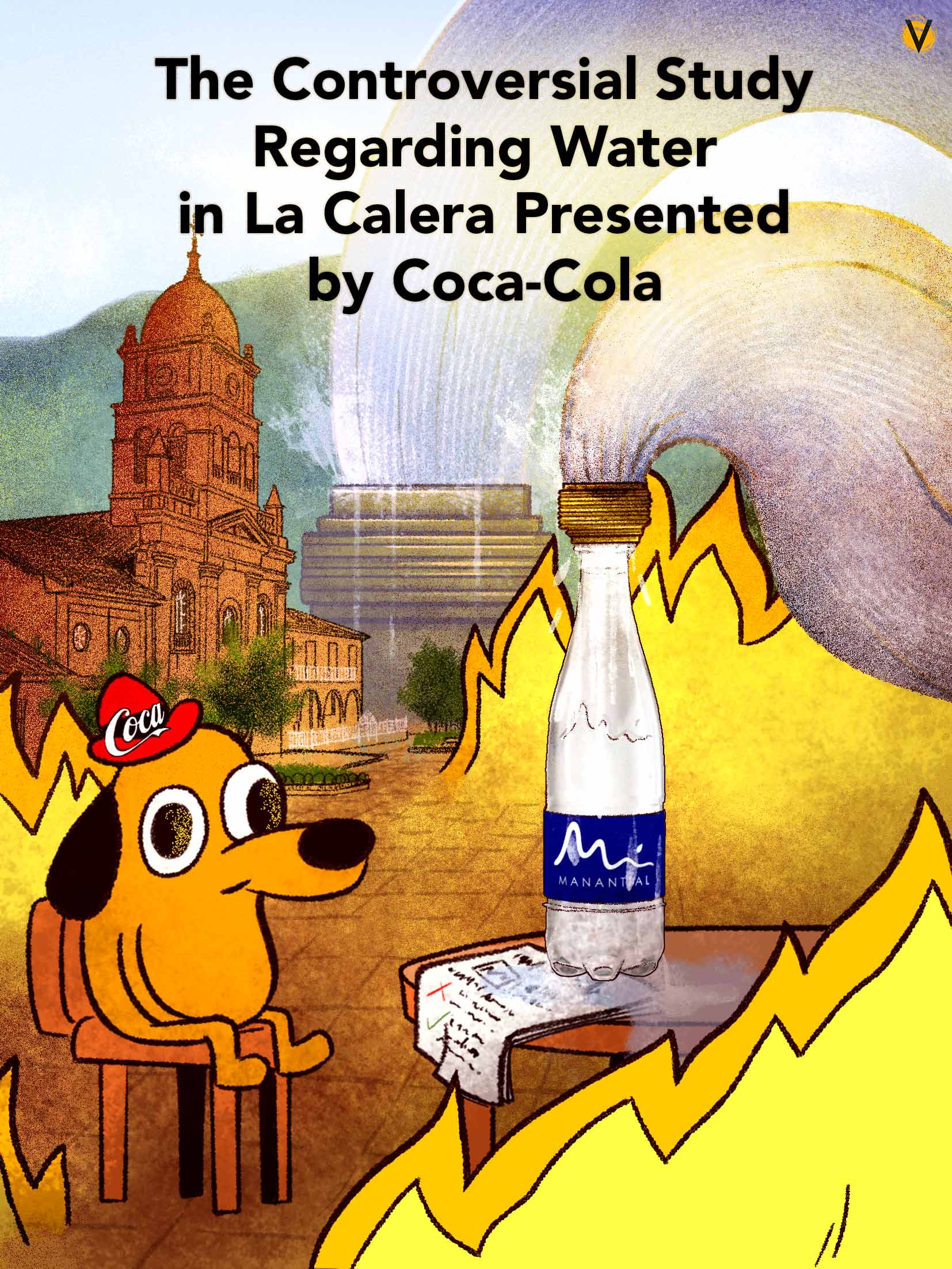
The Regional Autonomous Corporation of Cundinamarca (CAR) pointed out several inconsistencies in a technical report presented by Coca-Cola. The document is part of a series of files that Coca-Cola submitted to the CAR with their request for an extension of their groundwater concession in La Calera. The liquid extracted by the multinational is bottled under the Manantial brand. The CAR’s Office of Natural Resources determined that several of the measurements taken were unreliable.
Coca-Cola has bottled water in La Calera, even in the midst of severe droughts. In 2024, VORÁGINE revealed that in the rural areas surrounding the multinational’s plant farming communities were suffering from strict water rationing while the company continued to extract water as usual.
The CAR document addressed to their Bogotá-La Calera regional director, Sandra Milena Santafe, is dated September 30, 2025 and contains a technical evaluation by the CAR of the information presented by Coca-Cola in February of that same year. Hidrogeocol SAS is the company that prepared the study delivered by the multinational.
The Happy Basins
The CAR official who authored the 20-page memo found several inconsistencies in the study presented by Coca-Cola. Although the document is written in technical language, three water experts consulted by VORÁGINE have made it is possible to explain the findings in a simple way.
Crucial to the whole discussion is the data on water availability in the basin and the demand for the liquid. Precise data would make it possible to assess how the Coca-Cola concession affects the environment. The multinational company has a permit to extract 3.23 liters per second.
One of the CAR’s biggest questions regarding the document presented by Coca-Cola has to do with the data on which Hidrogeocol based its work. “The study used stations from other basins with rainfall amounts that differ from those for the area of interest,” the memorandum reads. Stations are points where the Institute of Hydrology, Meteorology and Environmental Studies (IDEAM) monitors weather conditions. The problem, according to the CAR, is that the company allegedly included data from places that are not related to the springs in question.
Robinson Carvajal, an environmental engineer with a master’s degree in Sustainable Water Management, is part of the Échele Ojito al Agua oversight group. This organization opposes the renewal of Coca-Cola’s concession in La Calera. In a dialogue with VORÁGINE, he explained that of the 13 stations whose data was analyzed, only three are related to the springs. “By using data from stations that are completely unrelated, they have overestimated the flow rate,” he stated. “Even though they analyzed stations with landscapes and altitudes as well as geological characteristics similar to those in the basin of interest, the waters are different,” explained Anyi Castelblanco, an anthropologist and graduate of Social Sciences whose undergraduate and master’s theses were on water distribution in La Calera.
According to Carvajal, the springs belong to the Bogotá River macro-basin, the Teusacá River basin, and the San Lorenzo micro-basin. The Mexican Institute of Water Technology defines a basin as: “a territory whose waters all flow towards the same river, lake, or sea.”
We also consulted David Trujillo, a civil engineer specializing in hydrology and hydrometry. Regarding the inclusion in the study of data from other basins, he stated, “The rainfall and temperature data is unreliable due to the use of stations located in other basins.”
“That they include stations in places outside the San Lorenzo micro-basin means they are adding water that won’t fall in this place,” Carvajal said. Part of the CAR analysis supports his statement. The CAR’S flow measurements total less than those reported by Hidrogeocol. The Office of Natural Resources drew attention to the differences occurring in the months with the greatest droughts: January, February, and May. Coca-Cola’s measurements for those periods were higher than those of the CAR.
“The estimated flows in the study are higher than those calculated by the CAR, especially during dry months, which points to an overestimation of the water supply, which in turn compromises the integrity of the aquifer and the ecosystems associated with it,” Trujillo explained. “The specific risks identified included a reduction of base flows in drought scenarios,” the entity warned.
“It’s strange that the company didn’t use the data already collected by the CAR. Furthermore, they’re working with completely different bodies of water,” Castelblanco said.
In other words, they would seem to have increased the data on the amount of available water so that any potential concession would face fewer obstacles. “They’re forcing the parameters to get the results they want. That’s what the CAR says,” Trujillo concluded. The entity explains it in technical terms: “It [the report] includes many assumptions in the adjustment and handling of the (Thomas Model) parameters that comprise the model, which are subject to manipulation in order to obtain results favorable to the interested party.” He also refers to the results of the Hidrogeocol study as presenting “a very optimistic outlook.”
Carvajal got to the crux of the matter: “When a lot of water is available and the demand for water is low, there is enough water for different uses. But if water is not available, then unfortunately the flow must be reduced or priority given to the uses established by law.” In other words, if there is only enough water for domestic consumption, priority should be given to that use, rather than the industrial use made by companies such as Coca-Cola.
Other Inconsistencies
The CAR’s Office of Natural Resources also questioned the time frame covered by the data. One of the stations used in the report provided data up to the year 2021, and another up to 2023. The remaining measurements cover only the period from 2007 to 2010, according to the CAR document.
“Rainfall and temperature maps do not adequately reflect the climatic variability of the study area, which directly affects water availability calculations,” Trujillo said. “The climatic conditions from 2010 or 2017 are not the same as those today. During those years, climatic conditions were more stable. “In other words, they don’t present current data,” Carvajal explained.
Another point of contention between Coca-Cola and the opponents of the concession extension is the origin of the water that feeds the springs. The CAR memorandum refers to this issue in one of its conclusions: “[the report] lacks isotopic validation that establishes with certainty the hydraulic connectivity, or absence thereof, between underground and surface water sources.” “Isotopic validation” refers to establishing the origin of the water.
“Their hydrogeological study claims that the water does not come from Chingaza, but rather that rainwater feeds the springs, which from a geophysical standpoint is not convincing,” said Carvajal. The conclusion reached by the CAR implies that the study submitted by Coca-Cola fails to establish with reliable data the origin of the water.
The CAR’s questions also extended to the company’s hydrogeological analysis —referring to the relationship of water to the subsoil. “Interpreting unconsolidated materials as rocks without considering their state can lead to errors in the hydrogeological model, such as overestimating or underestimating water flow capacity and porosity,” the document reads.
Carvajal explained the issue more simply: “They interpreted the type of rock mistakenly. So we can’t really know if the amount of water that exists is what they say it is, or if it’s less or more. In other words, this leads to an error, because gravel is not the same as sand; gravel rock is much more impermeable and will not allow for the same amount of water storage as a sand rock.”
In conclusion, the CAR declared that the Coca-Cola study was unreliable in several aspects. “These restrictions significantly limit the technical soundness of the model, preventing it from being considered a reliable tool to support the sustainability and environmental protection of the underground water resource in the study area,” the document reads. In addition, one of the data most relevant to a possible extension of the concession was not clarified: “The study, in its hydrological aspect, does not provide the technical proof needed to determine the actual amount of water that the analyzed basin can supply.”
The CAR went so far as to request “strict application of the Environmental Precautionary Principle, given the existing technical uncertainty in relevant aspects of both the studies presented and the concession’s area of intervention.” The precautionary principle would force Coca-Cola to close the plant until we have certainty about the data.” Carvajal explained. However, he does not agree with that measure at this stage of the process. He said that Coca-Cola has applied the principle of prevention and has complied with the CAR’s requirements. Furthermore, he opined that the Office of Natural Resources should refrain from providing legal opinions, which is the job of the legal office.
“The lack of certainty regarding the available information and potential impacts necessitates the adoption of preventive measures to avoid irreversible environmental damage, prioritizing the protection and conservation of underground water resources until definitive and sufficient technical knowledge is has been made available,” the CAR document concludes.
Defending Businesses
In a document that Coca-Cola sent to the CAR on October 3, 2025, the company criticized the conclusions of the technical memorandum. “If the alleged lack of information regarding the availability of underground water is what forces the adoption of the precautionary principle, at what point is it justified [to assume] that it is specifically the extraction carried out by INDEGA (Coca-Cola) that poses a danger of damage to the water resource?” it reads.
The multinational’s representative, Jairo Rodolfo Vega, expressed his “concern” about the memorandum’s conclusions. “As noted at the beginning of the report in question, the purpose of the technical analysis was to evaluate the study presented within the framework of the concession extension. It is not, therefore, an evaluation of the concession itself, which was duly granted and is in force,” he wrote in the document he submitted to the CAR.
When contacted by Vorágine, the multinational provided a brief response: “INDEGA S.A.S. is in compliance with the technical and legal requirements established by the environmental authority and operates in accordance with the law. It respects the administrative acts issued by the CAR and its technical and legal capacity to make a decision regarding the process and is also open to fulfilling any requirements. Likewise, to initiate the corresponding legal proceedings before the competent authorities.”
Hidrogeocol also sent a document opposing the CAR memorandum. The company defended its study: “There is no methodological flaw in including neighboring stations; on the contrary, it improves the spatial representation of average rainfall.” They also referred to the CAR’s statement that “favorable results for the interested party (Coca-Cola)” may have been sought: “Modern hydrology prioritizes calibration with available information and uncertainty analyses, maintaining consistency with the conceptual model and with transparently reported performance metrics.”
The company also addressed the allegations of overestimation of the water supply. “The report is not based on ‘optimistic’ assumptions, but on official data, multi-year averages, and an ABCD balance calibrated and consistent with the hydrogeological conceptual model,” the document reads.
The CAR has yet to decide whether to accept the recommendations of its Office of Natural Resources or the companies’ arguments and has not yet decided whether or not to extend the concession. At stake are the millions of liters of water that, at times, have not been available to thousands of farming families in La Calera.
Read also: La Calera: Water for Coca-Cola and Bogotá, but not for Its People
If you would like to share more information with us on this or other topics, please write to: [email protected]
* This content is funded by support provided, in part, by Vital Strategies. Content is editorially independent and its purpose is to shine a light on both the food and beverage industry illegal or unethical practices and the Colombian most vulnerable populations, who disproportionately bear the brunt of the global health crisis resulting from the unhealthy food and beverages consumption. Unless otherwise stated, all statements and materials posted on this article, including any statements regarding specific legislation, reflect the views of the individual contributors and not those of Vital Strategies.

Periodista de Vorágine. Ha cubierto temas relacionados con violaciones a los derechos humanos, corrupción y conflicto armado, con especial énfasis en la responsabilidad de sectores empresariales en la guerra en Colombia. Durante cuatro años fue reportero en El Espectador, donde cubrió la implementación del Acuerdo de Paz firmado por el Estado y las Farc en 2016. También ha trabajado con diferentes medios independientes. Fue guionista, asistente de dirección e investigador del documental ‘Operación Berlín: la niñez que peleó la guerra en Colombia’. En 2018 ganó el premio Fernando Quiñones por una crónica sobre la guerra entre el Eln, las Autodefensas Gaitanistas de Colombia y la Fuerza Pública en la parte baja del río San Juan. Fue tallerista y compilador del libro ‘Les di la mano, tomaron la piel’, publicado en 2017 y que reunió los textos de 23 niños víctimas del conflicto que participaron en talleres de literatura liderados por la fundación Fahrenheit 451 y Huella Indeleble (organización de la cual fue cofundador).
Si quieres contactar a Nicolás, escribe a [email protected]
Artículos Recientes
Coca-Cola has sponsored the Olympic Games since 1928 and the FIFA World Cup since 1978. Profit and “image-washing” efforts aimed at diverting attention...
#EscuelaVorágine abre inscripciones al taller virtual sobre cómo adaptar obras de la literatura a guiones audiovisuales. Los cupos son limitados, asegura...
Mongabay Latam y Vorágine revelan cómo las disidencias de este jefe guerrillero arrasan con la selva de este departamento colombiano mediante un modelo...

El paso del tiempo, el conflicto y la geografía adversa complican la búsqueda de personas desaparecidas en la frontera sur. La falta de coordinación...