Half-baked Implementation of PLATOS Legislation: The Tension Behind Healthy School Food Policies in Cali
Implementation of the “Local Plan for Totally Healthy Eating” (PLATOS, in Spanish) has raised red flags regarding possible industry interference. The legislation seeks to eliminate products with warning labels from school snack shops.
15 de julio de 2025
Por: Luis Bonza Ramírez* / Ilustración: Juanita Chavarro
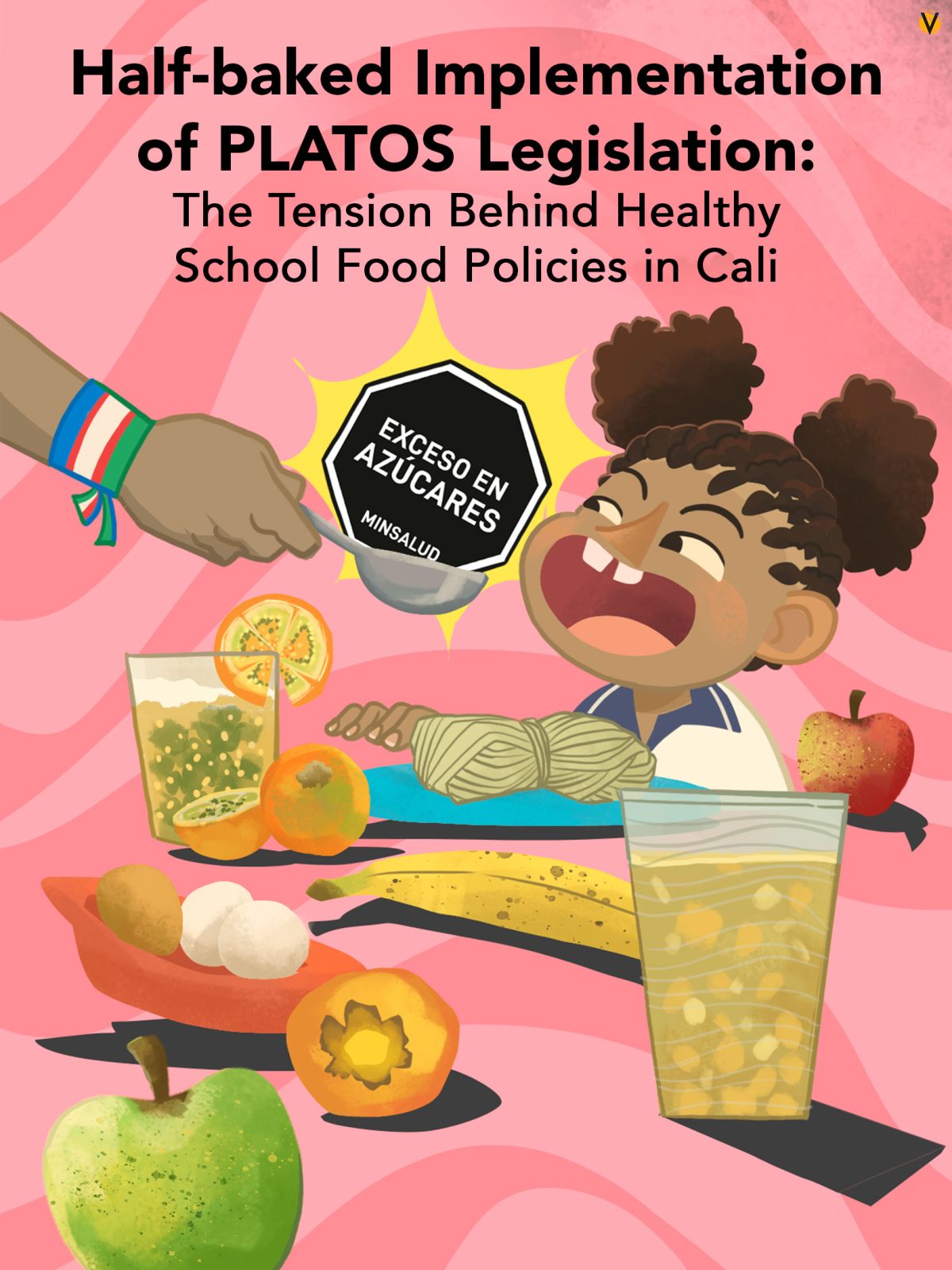
A meeting held in late January 2025 at City Hall in Cali raised alarms among organizations advocating for children’s and adolescents’ right to health. The meeting was convened by the National Association of Entrepreneurs of Colombia (ANDI, for its Spanish acronym) and attended by officials from the District Ministries of Health, Education, and Economic Development.
The meeting discussed Decree 918 of 2023, which mandates measures to transform public and private schools in Cali into healthy food environments. Among these measures is the staged withdrawal of ultra-processed products with front warning labels from all school snack shops within eighteen months.
The first to sound the alert was the NGO Red Papaz. On February 20, the NGO issued a statement denouncing the meeting, of which no public record existed at the time, as seeking to review—and possibly modify—the decree known as PLATOS.
“We object to the interference from this organization, which we know from previous experience specializes in torpedoing health initiatives that they believe could affect their members’ pocketbooks,” the Red Papaz document states.
Four days after the complaint was filed, Camilo Montes, executive director of ANDI’s Food Industry Chamber, confirmed that the meeting took place, but told Blu Radio that “it is quite manipulative to say that we went to that meeting to keep a decree from being implemented. We went, in the spirit of positive collaboration, to find a way, based on our common goals, to ensure that children eat better.”
The position of the Cali Mayor’s Office’s regarding the meeting has been ambiguous. The meeting on January 28th with the ANDI has been called a “work session”, a “negotiation session,” or an “informative meeting,” depending on the official or the department. In a petition filed on March 26 by Leidy Tatiana Aguilar, the Secretary of Education until April 3, there were even claims that the meeting never took place.
“No evidence was found of any meetings scheduled or invitations from industry sectors or their union representatives to discuss education-related issues in the last six months,” reads the response received by the José Alvear Restrepo Lawyers’ Collective (CAJAR), an organization that has monitored the decree.
Before her resignation, however, the now former Secretary of Education told VORÁGINE that her office did participate in a working group with the ANDI, “where the process of formulating Decree 918 of 2023 was discussed.” This meeting made it possible for the ANDI to be informed of the scope of the decree.”
Cali’s Undersecretary of Public Health, Carlos Pinzón, denied that the meeting resulted in any type of interference and explained that ANDI “is an actor like any other, an actor that I don’t know if it’s legitimate or not, but whose intention is to know and place certain concerns on the table. The fact that we sit down with them is an act of transparency on our part, and in technical terms, political governance.”
He added that it was not a secret or hidden meeting: “The encounter did not take place under a bridge or in a cafeteria; it happened in the offices of the administration and the rules of the game at that table were made clear to ANDI: it was not a consultative, but an informative meeting.”
The disputes over the implications of the meeting between the Mayor’s Office and the ANDI are symptomatic of the obstacles to implementing Decree 918 of 2023, which seeks to improve the nutrition of children and adolescents in Santiago de Cali. Implementation of the decree was scheduled for completion in June 2025, but has made little practical progress.
‘Choosing between a piece of fruit and a packet of chips is not the same thing.’
The Local Plan for Totally Healthy Eatingwas signed on December 12, 2023, during the last days of then-Mayor Jorge Iván Ospina’s administration. It was approved primarily due to political advocacy on the part of the Healthy Cities Alliance—comprised of Vital Strategies*, the World Health Organization, and Bloomberg Philanthropies—and to support from Red Papaz.
74 cities around the world are part of this alliance, three of them in Colombia: Bogotá, Medellín and Cali. Its purpose is to support the creation of public policies for the reduction and prevention of non-communicable diseases, such as diabetes and obesity.
“The premise is that a child goes to school and is in a protective place. Part of this protection lies in the foods available at school, because excessive consumption of ultra-processed foods and sugary drinks causes non-communicable diseases,” explains Melissa Córdoba, the Healthy Cities Alliance’s regional deputy director for Latin America.
According to the latest National Nutritional Situation Survey (ENSIN), the percentage of overweight children in Colombia between 5 and 12 years of age increased from 14.4% to 24.4% from 2005 to 2015. In Valle del Cauca, according to the same survey, 30 out of every 100 children are overweight, and in Cali, the figure is 35 of every 100.
Data collected in 2021 by the Cali Health Secretariat indicate that 18.6% of boys, girls, and adolescents that year were obese and 16.7% were overweight.
“We take into account certain experiences in other places that support findings that these policies work in the short term, because children who eat better have better attention spans, and in the long term, they will run a lower risk of suffering from diseases related to the consumption of these ultra-processed products,” adds Córdoba.
After the decree was approved, the organizations that promoted it created a strategy to disseminate it under the name PLATOS, including promotion of traditional Cali cuisine in the daily diet of the city’s children and young people, as an alternative to consuming ultra-processed products.
Among the foods allowed by the decree are lulada and champús, for example, both fruit-based beverages typically enjoyed in the Cauca Valley. “This is the spirit of the decree—real food—, because ultra-processed food is artificial,” states Córdoba.
Eliana María Pérez is a teacher and researcher with a PhD in public health, and a member of the Public Nutrition Issues Unit at the Universidad de Antioquia’s School of Nutrition. In order to differentiate between what is food and what is an ultra-processed edible, she suggests a simple exercise.
“If you understand what’s on the label of what you’re eating, it’s a natural food or simply “processed.” For example, you know what wheat flour and palm oil are, you can buy them, but who has inverted sugar in the house? “Or what does tartrazine or dye 42 look like?” Pérez asks.
The component of the Local Plan for Totally Healthy Eating in Cali that has generated the most tension is the elimination of ultra-processed food products from school snack shops. The proposal calls for a gradual transition: in the first six months, starting in January 2025, products with a maximum of two octagonal warning labels can be sold; after the first year, a maximum of one label; and after 18 months of implementation, no product with a label can be sold.
During 2024, according to Cali’s Undersecretary of Public Health, Carlos Pinzón, interventions took place in fifty shops, with four more taking place so far in 2025. These educational institutions no longer offer products with two or more warning labels. There are a total of nearly 420 schools in the city, between public and private institutions.
The main difficulty, explains the official, has taken the form of resistance from shopkeepers, worried that their profits will be reduced if they’re selling less of these packaged products. “But we’ve also encountered resistance from customers, children, and adolescents, because they’re used to eating chips, and not finding them creates resistance to change,” Pinzón adds.
Illustrated Infographic: School Snack Shops: Unregulated and at the Mercy of the Ultra-processed Food and Sugar-Sweetened Beverage Industry
Promoting healthy eating involves more than defining what can and cannot be sold in a school snack shop. It also means contesting the symbolic and emotional terrain where the ultra-processed food industry has established a strong foothold. Melissa Córdoba warns of this:
“When industries launch advertising, include toys in products, or position their packaging on the most visible shelves, they are already influencing our decisions. We are not choosing between a piece of fruit and chips on equal terms: the industry constantly manipulates our choices, not only with the product, but also through the feelings it generates.” she says.
Córdoba believes the industry’s debate about a supposed loss of freedom of choice is ill-founded; this freedom has long been conditioned. She says there is a clear difference: There is no multi-million dollar advertising machine behind public health to help sell an apple, for example.
The strategies that influence our decisions when consuming one product or another should be attributed, says Professor Pérez, to a “corporate food regime that tells you which products to consume, their characteristics, under what conditions, how you can acquire them, the price, and the geographic location of the stores. These powerful players determine the food we eat.”
Among the ways the industry captures consumers’ attention is, for example, providing refrigerators, display cases, and kiosks that bear their brands. For this reason, the decree also included a pilot in which ten schools have been equipped with refrigerators, ovens, and other items needed for food preparation in shops, with no brand logos or advertising.

The ‘Sugar’ Mayor
Although the decree was signed by Ospina, its implementation fell to the current mayor, Alejandro Eder, who took office on January 1, 2024. The administrative change, which included transfers of duties, hiring, and the approval of the District Development Plan, delayed implementation by a full year.
The decree states that implementation should be carried out within a maximum period of 18 months, which means full implementation by June 2025. However, by June of this year a mere six months will have passed since the actual implementation began in January.
The delays in implementation, along with the meeting attended by officials from the Mayor’s Office and the ANDI, have raised suspicions among organizations monitoring compliance with the decree. Added to these suspicions are concerns regarding Mayor Eder’s relationship with the sugar industry.
The Eder family owns Manuelita SA, the oldest sugar company in Colombia. An additional five sugar companies, including Manuelita, Riopaila, and Mayagüez, also contributed more than 450 million pesos to Eder’s successful mayoral campaign.
“I would hope that the mayor understands that his current role is that of a public policy decision-maker. We want to believe that this will be the case and that the process won’t be hindered, but all of this continues to cause us great concern. I feel like nothing has happened this year, and this whole situation has put a bit of a damper on the progress made so far,” says Carolina Piñeros, director of Red Papaz.
Although the decree was not implemented in 2024, according to former Education Secretary Leidy Aguilar, the Local Plan for Totally Healthy Eating was shared with shopkeepers, principals, and the educational community. Certain schools have gone beyond what is on paper, but it has been of their own volition.
One example is Gimnasio La Colina, a private institution that no longer offers products with warning labels and whose nutrition committee provides guidance to families. Its school snack shop was also recognized by Red Papaz as a “healthy shop”.
On the other hand, some school principals still don’t know what the decree is about or what implications it has.
José Aníbal Morales is the principal of the Golondrinas Educational Institution, a public school located in Cali’s rural surroundings. In conversation with VORÁGINE, he explained that his school has proposed holding a monthly “Healthy Day,” during which school snack shops offer products other than ultra-processed foods. This strategy, however, was the school’s own initiative; when asked about the decree, he said he wasn’t familiar with it nor had he taken part in any socialization about it.
According to the director of Red Papaz, “public schools require more support because they face different challenges. There are even cases in which schools will not be able to comply with the decree simply because they lack the necessary sanitary conditions.”
PLATOS also regulates the promotion of water consumption in educational institutions, to replace sugary drinks. But some schools don’t even have access to the public drinking water network. In these cases, which according to Undersecretary Pinzón are schools located in rural areas around Cali, “progress is being made on strategies to deliver the resources.”
Report: Cartagena’s difficulties in implementing the healthy school food environment policy
PLATOS Under the Magnifying Glass
In an interview with Blu Radio, Camilo Montes, executive director of the ANDI’s Food Industry Chamber, in addition to referring to Red Papaz’s claims as manipulative, said that the NGO’s director, Carolina Piñeros, is “ill-tempered.”
These kinds of accusations, which seek to delegitimize the messenger rather than debate the message, are common, according to Piñeros. “It’s partly the role of civil society organizations to be there, to be attentive, and we know that we sometimes make others uncomfortable. During another encounter in Congress, for a bill to restrict advertising, I was the target of other personal attacks, and Red Papaz was also attacked,” she says.
ANDI has made three requests to the Cali Mayor’s Office in relation to Decree 918: to open a technical debate to decide whether or not products with warning labels can be sold; to evaluate the impact of the measure on micro and small businesses in the region; and to improve the presentation of healthy products in school snack shops, as well as the quality of the prepared foods on offer.
Piñeros, however, believes there is no possible debate given that the industry’s intentions are contrary to the decree. “How are you going to be part of the solution if your products are damaging children’s health? This doesn’t mean prohibiting their sale, but rather placing restrictions on the way they are marketed, sold, and made available,” she points out.
Cartagena was the first city in the country to create public policy in defense of school-age children’s and adolescents’ right to adequate nutrition. And yet, a year after the legislation was signed, it has yet to be implemented. An example of the difficulties these types of initiatives face in moving from paper to action, even when they have legal backing.
The Cali Education and Health Secretariats told VORÁGINE that the decree’s implementation remains in place and that there have been no changes to its content. Undersecretary of Public Health Pinzón was emphatic that none of ANDI’s requests were addressed in the meeting attended by the Mayor’s Office, adding that “it’s not a bad idea to listen to a stakeholder and we shouldn’t stigmatize by saying that regulations will always be ignored, because sometimes they may be, and sometimes they may not.”
The Local Plan for Totally Healthy Eating still has another year to go before it’s fully operational, but the vigilance sparked by the meeting at the beginning of the year will continue throughout its implementation. Those monitoring this process are confident that, over time, it won’t be officials but the results themselves that will speak for the success of PLATOS.
* This investigation was funded, in part, by Vital Strategies. The content is editorially independent and is intended to shine a light on illegal or unethical practices in the food and beverage industry and on the fact that it is the most vulnerable populations who disproportionately bear the brunt of the health crisis caused by the consumption of unhealthy food and beverages. Unless otherwise noted, all statements published in this story, including those regarding specific legislation, reflect the views of the particular organizations, and not of Vital Strategies.
Artículos Recientes
VORÁGINE recibió testimonios de cuatro personas del Ministerio de Educación que señalan presiones de la jefa de prensa de la entidad para que fueran...
El candidato adquirió un predio sobre un título minero que perteneció al ‘Comandante Barbie’ y su familia. La propiedad colinda con fincas del mismo...
VORÁGINE discloses a technical report from the CAR pointing out the inconsistencies in a study presented by Coca-Cola in which they allegedly exaggerate...

VORÁGINE encontró indicios de que quienes pagaron el sondeo son cercanos a algunos candidatos, sin que eso se informara al público. César Caballero,...