Coca-Cola’s strategy to clean up its image at the World Cup
Despite the harmful impact its products can have on human health and the environment, the multinational has been a sponsor of the world's most-watched sporting event for 48 years. Here’s how their sportswashing strategy works.
16 de abril de 2026
Por: Mariana Guerrero / Ilustración: Fabián Ospina (@fideoilustracion)
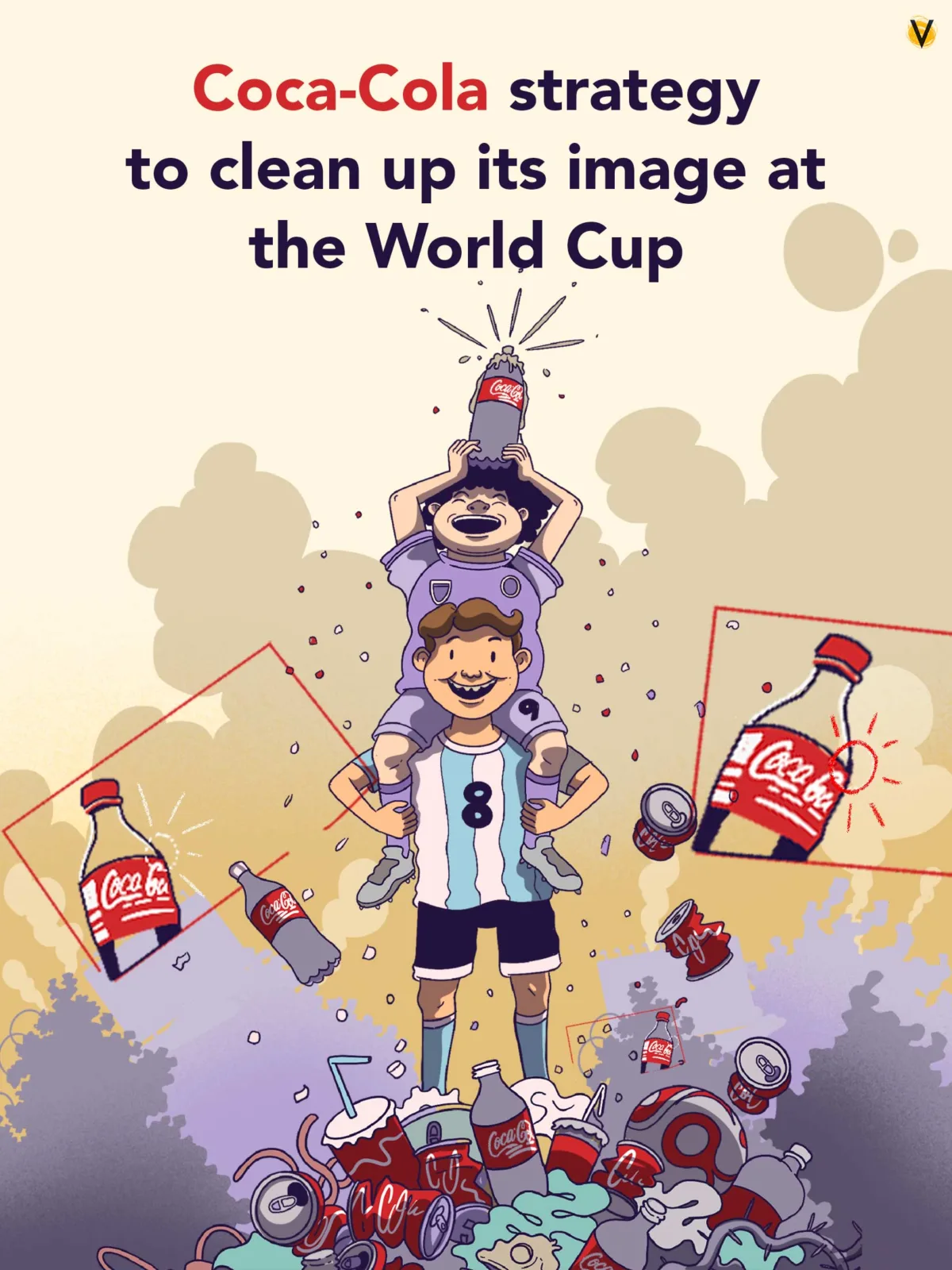
In June 2018, FIFA president Gianni Infantino received more than 7,600 emails asking him to suspend Coca-Cola’s sponsorship of the 2018 World Cup in Russia. The FIFA did not respond with a public statement or an open debate, but instead remained silent and blocked the email accounts from which the messages had been sent. Eight years later, in 2026, accusations of sportswashing persist and demands for action are growing.
With the World Cup scheduled to take place in Mexico, Canada, and the United States in just three months, international organizations are once again questioning what they consider an unjustifiable contradiction: promoting products associated with health risks at the planet’s most-watched sporting event. In 2018, more than 3.5 billion viewers tuned in and the Qatar 2022 final between Argentina and France captured the attention of 1.5 billion people.
In 2024, the same demand extended to the Paris Olympic Games, including a call to end Coca-Cola’s sponsorship of the event as a public health measure. The multinational company behind the world’s best-selling soft drinks has maintained this link with the Olympics since 1928. “The contradiction lies in the fact that although the primary goal of sporting events is to promote healthy standards or practices such as mobility or physical activity, the same events are broadcast alongside advertising for products that are bad for one’s health,” explains Adriana Torres, researcher and coordinator of Dejusticia’s Office of Economic Justice.
In this context, more than 530,000 people have joined the ‘Kick Big Soda Out’ movement with the goal of stopping companies in the soft drink sector from whitewashing their reputation through sports, prioritizing profits above public health. Other initiatives such as the El Poder del Consumidor (Power to the Consumer, in English) movement in Mexico have filed complaints with government bodies, denouncing Coca-Cola’s strategies to “clean up their image” through mass advertising. This type of advertising has begun appearing in other countries, including Colombia, and, as experts point out, it lacks transparency towards consumers.
Other reports about Coca-Cola in VORÁGINE: David and Goliath: The Struggle Between Coca-Cola and Colombia’s Indigenous Nasa People
Nearly 50 Years of Advertisements
Trips to attend World Cup matches, photographs with the official trophy, and an alliance with Panini to insert 12 of the famous album’s stickers on soft drink labels are among Coca-Cola’s commercial sponsorship strategies. The problem is, these advertising campaigns fail to warn of the harmful effects of consuming their products and, in some cases, the bottles carry none of the black, octagonal warning labels that indicate that their products contain excess sugars or calories.
Experts call these practices sportswashing, or sports whitewashing, referring to the use of sporting events as a way of improving a company’s reputation, or to deflect attention from the negative effects of its products. “Sponsorship distorts or obscures the sugary beverage industry’s responsibility with regard to the very issue we’re concerned with: improving people’s health,” Torres points out.
Alejandra Niño, a researcher at FIAN Colombia, an organization that works for the human right to adequate food and nutrition, adds that these strategies focus the conversation on physical activity without addressing the already proven impact of consuming sugary drinks and ultra-processed products on people’s health. A 2025 study published in the journal The Lancet showed that elevated consumption of these types of products has 32 negative effects on health. And research in 2023 by the Global Food Research Program revealed that consumption increases the risk of hypertension and cardiovascular accidents by 23% and 35%, respectively. Another study by the United States’ National Institutes of Health (NIH) concluded that consuming ultra-processed foods—including sugary drinks—is in fact linked to the development of type-2 diabetes, a disease that in 2022 was the eighth leading cause of death in Colombia, according to data from the Integrated Social Protection Information System (SISPRO, for its Spanish acronym).
During the 48 years that Coca-Cola has been one of the World Cup’s main sponsors, the company has consolidated an entire advertising strategy focused on the event. As part of this year’s plan, for example, it created various social media accounts in Mexico focused on the soccer event, according to Ana Larrañaga, a member of El Poder de Consumidor. Among them is the company’s Coca-Cola Fútbol Instagram account, and the hiring of macro-influencers with up to 20 million followers on social media. In Colombia, in addition to content creators, Coca-Cola has collaborated with soccer football players such as the former captain of the Colombian National Team, Mario Alberto Yepes, defender Yerry Mina, and right-back Santiago Arias.
The Poder del Consumidor organization filed a complaint before Mexico’s Federal Consumer Protection Agency and the Federal Commission for Protection against Sanitary Risks because, according to the country’s General Health Law, Coca-Cola is under obligation to make the warning seals visible in its advertisements. In Colombia, VORÁGINE confirmed that most of the multinational’s advertising fails to display the seals. However, the regulations governing this issue (Resolution 2492 of 2022) are not clear on whether or not display of the seals is mandatory.
“Placement of these labels is desirable because effectively they bring with them the possibility that the consumer, specifically children and adolescents, can read the label, see it, and have a chance to learn about the effects of these products in order to make an informed decision,” says Adriana Torres.
Niño, for her part, interprets this as sending the wrong message. She believes that the absence of warning labels in advertising conveys the idea that something about the product has changed. “The fact that they don’t really show what the product is or how it is marketed gives the false notion of healthiness,” she points out.
In addition to the multimillion-dollar advertising strategy—it is estimated that Coca-Cola pays FIFA between $120 and $200 million for each World Cup—is the exchange of gifts for the purchase of Coca-Cola products. In Colombia, for example, the Golden Cap campaign offers prizes to soccer fan consumers, including free trips and tickets to matches. And in Mexico, special-edition pins can be collected by buying soft drinks; in other words, encouraging the constant consumption of these drinks. Coca-Cola is also in charge of the World Cup trophy tour, which visits several cities prior to the championship.
FIAN Colombia researcher Niño states emphatically that this is a public health issue: “The relationship between the excessive consumption of these products and their presence in our environments is widely proven. This causes problems such as excess weight, which can then lead to various diseases. So, to soften or dilute the conversation, the discourses that emerge are that the conversation should focus on the amount of physical activity going on and the importance of an energy or calorie balance. The message they send is that it doesn’t matter what product you consume or how often you consume it, as long as you burn the calories in the product. But we know that’s false.”
In addition to influencers and fans, El Poder del Consumidor points to the presence of politicians and officials at these events, which makes the content of the message received by the public even more confusing. “The presence of governors or government or municipal authorities conveys the idea of institutional or governmental legitimation. Many people might assume that ‘if this product were so terrible, then they wouldn’t be taking a picture with the logo’. “This contradicts public health policies,” Larrañaga explains.
According to FIFA’s Qatar 2022 report, the World Cup attracts more than 3 million in-person attendees and more than 5 billion viewers around the world. And Coca-Cola’s strategy as a sponsor of the event seems to be paying off because the company reported that revenues in 2025 totaled nearly $48 billion USD, 2% more than reported in 2024.
“As sponsors who partially control the logistics of these spaces, they also determine which products are available. The option to choose is lost,” says Alejandra Niño. According to Angélica Farfán Liévano, director of Universidad Javeriana’s Environmental Sustainability Laboratory, this boils down to building positive reputational capital instead of addressing the issues they should actually be addressing: the harmful health impacts that their products can generate.
You may also be interested in “La Calera: Water for Coca-Cola and Bogotá, but Not for Local Citizens”.
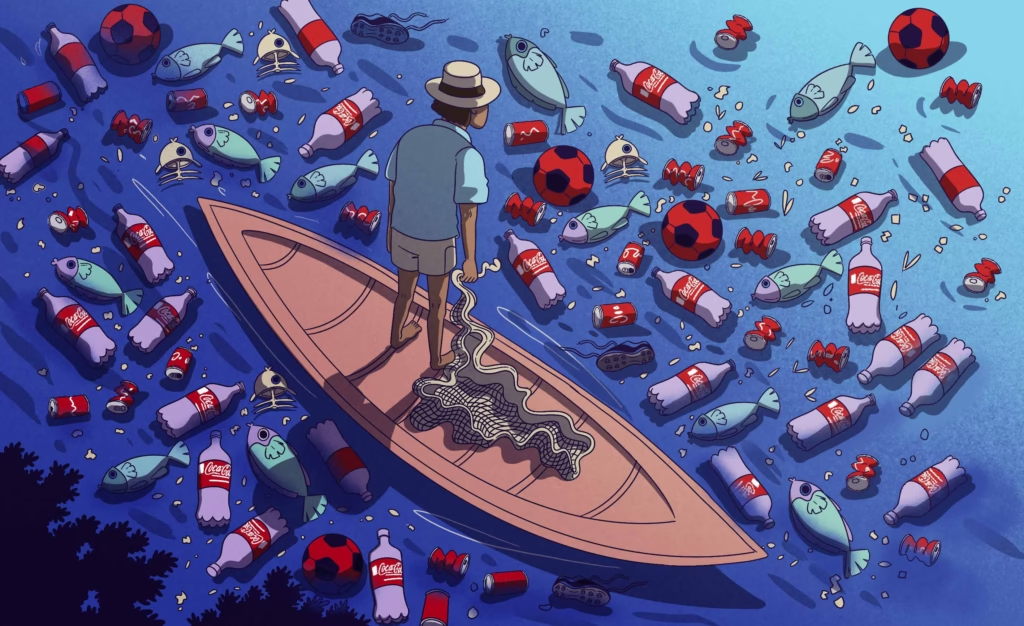
Social Responsibility or Business Strategy?
Coca-Cola’s strategy also includes social responsibility programs. Practices that, according to Adriana Torres, help “companies to manage the impact that their products have on economic, social, and environmental aspects.”
For example, on its official website, the multinational promotes its “GIRA Mujeres” program, which offers tools for entrepreneurship. It also offers programs that accompany elderly people or support local communities.
“One might say that these campaigns are not problematic, but when they are used for self-promotion, their objective is distorted. They divert attention from the real impact their products have on planetary human health, and that’s where the ads start to become problematic,” Torres points out. According to the expert, responsibility for the impacts on health ends up being transferred to the consumer.
This is not something that happens only with Coca-Cola. On the contrary, it is a widely documented strategy in companies across different industries. “Corporate and business social responsibility is designed to improve the company’s image or positioning, but it does not necessarily have transformative aims. They accomplish that, for example, through foundations,” explains Alejandra Niño.
In Coca-Cola’s case, the Coca-Cola Foundation was created in 1993 and has a global presence. The company’s official website states that it has invested more than $1.7 billion to support different initiatives around the world, such as sustainable access to drinking water, watershed conservation, recycling value chains, and disaster preparedness, among others.
And this is no coincidence; the company has made public its intention to contribute to six of the Sustainable Development Goals (SDGs). For example, it commits to responsible water management and developing projects to regenerate water. Coca-Cola Femsa’s 2024 accountability report even claims that 100% of the water used by the company in Mexico was returned to the communities.
This practice is known as greenwashing and expert Farfán Liévano describes it as a misrepresentation of information or a practice to divert attention from a company’s negative impact on the environment. “Greenwashing refers to a disconnect, in environmental terms, between what a company actually does and what it says it does. Often the negative impacts go unpublicized, so the positive aspects are exaggerated. It’s greenwashing through information,” he says.
In Coca-Cola’s case, the positive information put out by the company contradicts complaints made by academics, senators, NGOs, and environmental groups in Mexico. Between 2024 and 2025, for example, protests took place in the community of San Cristóbal de las Casas, in Chiapas, due to an alleged shortage of drinking water caused by Coca-Cola’s extraction of more than 1.14 million liters per day from the Huitepec volcano. The company paid around 2,600 Mexican pesos per year (500,000 Colombian pesos) for their extraction permit, which the community asserts is disproportionate to the company’s profits and the environmental impact it produces.
These complaints have been replicated in other Mexican states, such as Veracruz, and in Colombia. VORÁGINE revealed in 2024 that Coca-Cola Femsa has an extraction permit for 3.23 liters per second from seven water sources in La Calera, a neighboring municipality of Bogotá. The area is key to supplying water to the capital, but its inhabitants suffer constant water rationing. According to that investigation, in 2022 Coca-Cola paid only 4.7 million Colombian pesos for the water it extracted from La Calera (about $1,100 USD at the time).
Something similar happens with recycling. Coca-Cola has claimed that one of its goals is to reduce, reuse, and recycle all the packaging it puts on the market. “We will collect each and every one of them. Our main agricultural ingredients are sustainably sourced,” they post on their website.
However, there’s a wide gap between this promise and reality. “Evidence has shown that the possibility of actually reusing or recycling the materials in those products is quite limited. In any case, we would have to study the real possibilities that bottles or packages can be recycled in order to be reused,” says Adriana Torres, from Dejusticia.
And another key factor comes into play at this point: responsibility for the negative effects of the product on the environment is passed on to the consumer, when it actually lies with the company.
See the VORÁGINE report Manipulation, Addiction and Interference: Advertising Strategies for Ultra-processed Foods Targeting Children
The impact of these strategies is not neutral. Thanks to Coca-Cola sponsorship, children and teenagers—one of the main audiences for events like the FIFA World Cup, and who are in a fundamental stage of physical and cognitive development—are constantly presented with advertising for sugary and sweetened drinks in spaces associated with health and physical activity.
Experts consulted warn that the lack of regulation allows these practices to continue without restrictions. In Colombia, at least four attempts have been made to get Congress to approve a bill regulating the advertising of ultra-processed foods aimed at children and adolescents, but they have been consistently blocked by the food and beverage industry lobbies.
Experts also point out that these sponsorships contribute to building brand loyalty from an early age. Brands are associated with experiences of euphoria, play, or belonging. According to evidence, this association can hinder the ability to make informed decisions about food and health later in life.
As part of this process, sports, environmental sustainability, and social causes serve as platforms to project a positive image, while the impacts associated with the consumption and production of ultra-processed foods are relegated to the background or diluted in million-dollar messages.
* This content is funded by support provided, in part, by Vital Strategies. Content is editorially independent and its purpose is to shine a light on both the food and beverage industry illegal or unethical practices and the Colombian most vulnerable populations, who disproportionately bear the brunt of the global health crisis resulting from the unhealthy food and beverages consumption. Unless otherwise stated, all statements and materials posted on this article, including any statements regarding specific legislation, reflect the views of the individual contributors and not those of Vital Strategies.

Periodista de Vorágine. También politóloga egresada de la Universidad del Rosario. Bogotana y feminista. Trabajó como periodista en EL TIEMPO, Portafolio y Revista Volcánicas. Fue integrante de la décima generación de la Escuela de Periodismo Multimedia de EL TIEMPO. Ha colaborado para medios como Rutas del Conflicto y Pacifista en temas de conflicto armado. Becaria en 2023 del programa Equal Measures 2030 y parte de la octava generación de la Red Latam de jóvenes periodistas de Distintas Latitudes. Nominada en 2022 al premio Otto de Greiff por un especial multimedia sobre la persecución y el asesinato a líderes y lideresas afro e indígenas del norte del Cauca.
Artículos Recientes
The congressman seeking to overturn taxes on ultra-processed foods received a donation from a foundation with links to sugar producers. Meanwhile, the...
Ana Lucía Pineda, esposa del presidente, viene de dos familias con conexiones políticas y económicas en Montería. La llegada a la casa Nariño ha influenciado...

El reclutamiento forzado de menores de edad en este departamento del sur colombiano dejó de funcionar bajo la amenaza de las armas. Ahora es una macabra...

Tras 22 días de desaparición, un arriero encontró por accidente el cuerpo abandonado del comunicador de 25 años. VORÁGINE reconstruyó las pistas...